Senator Marshall Joins the American Ag Network to Discuss E15 & USMCA Trade Deal with Mexico
Washington – On Wednesday, U.S. Senator Roger Marshall, M.D. (R-Kansas), joined the American Ag Network’s Agriculture of America with Jesse Allen to discuss President Trump’s support of year-round E15, the USMCA Trade Deal with Mexico, duopolies in agriculture, and more.
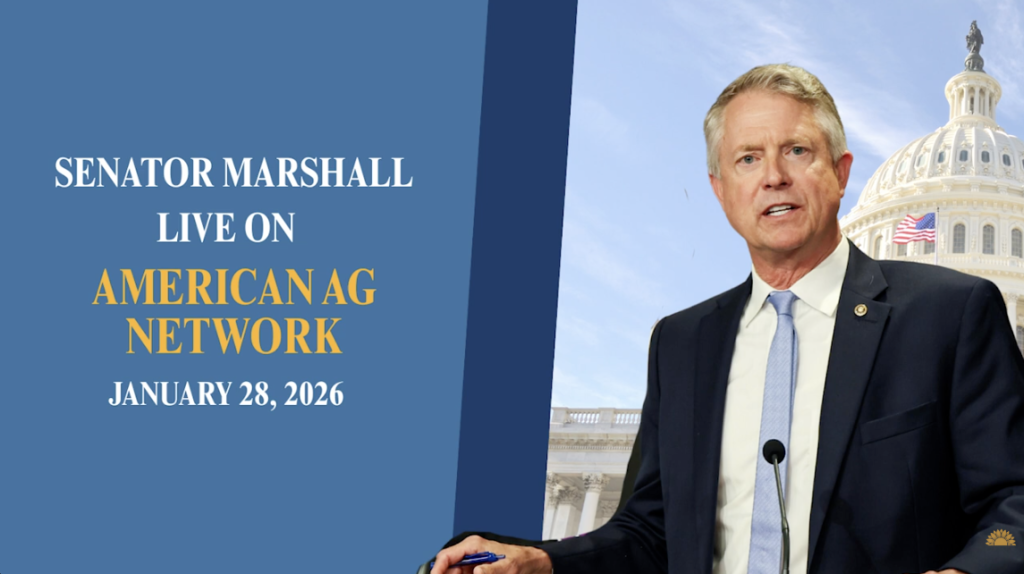
Click HERE or on the image above for Senator Marshall’s full interview.
On a possible government shutdown:
“Yeah, Jesse, I think Vegas has it right; Vegas is saying an 80% chance of a shutdown. If anybody tells you they know what’s going to happen, run away from them. I think it’s up in the air. I think both sides realize that no one benefits and no one wins when there’s a shutdown. So, I’m going to work my hardest to keep the government open. If it does shut down, I’m hoping it’s just for the weekend, but all bets are off. People are just now getting back to D.C. We’ve all had, you know, trouble with Snowmageddon back in our home states, just trying to get here. So those talks are really just starting to get serious and heated up.”
On the President’s support for year-round E15 legislation:
“You know, I think this is our top goal. For people from ag states, this is so important, and it was great to see the President lean into the issue publicly. You know, big oil is kind of the other side on this, but it’s really the small refiners that are upset; they want these small refinery exemptions. But let me just explain how important this is to the American farmer. If we went to E15, this could mean another 2 billion bushels of corn consumed. We usually export about that much, so it’s almost like doubling our exports without having to go through the drama of dealing with China and some of those other countries. So, it’s a huge priority for us, I think we’re really close. You know, the challenge is now, with the oil down to—goodness—$58 a barrel, down from [the] 70s and 80s, oil is kind of squealing right now. So, it’s a huge priority, but the biggest news of the week is President Trump leaning into it yesterday in Iowa. So, I think that’s the big news.”
On the U.S.-Mexico agricultural trade relationship:
“You bet, Jesse, and I need your listeners’ help, and I’ll explain why here in a second. But Mexico is now the number one trade partner of America. A trillion dollars a year of trade, it’s a million jobs. Mexico is the number one trade partner for agriculture for Kansas. I’ll speak for Kansas: 70 to 80% of our ag exports go to Mexico, so it’s vitally important. This summer, the USMCA trade agreement will be up for review, and what I need is your listeners to go down to Mexico. Look, emails aren’t going to work with everybody. We need to go down there and shake the hands of our good partners in Mexico and say, ‘Thanks for your business.’ Look, it’s much easier to keep a good customer than to go out and find a new one. Look, I know Mexico is not perfect, but it’s working, and they’re much more dependable than China is right now. And that’s what I did; we took, I think, about seven different ag groups there, and we all said, ‘Thank you, and where are the opportunities?’ I think there are more opportunities ahead of us, but everyone needs to be saying thank you and letting the White House know how important this agreement is to agriculture.”
On whether the USMCA extension will be challenged:
“Well, look, we sure don’t want that to be the case. Look, the national media is going to do everything they can to drive up the drama of this thing, so we need to stay focused on the positive of this. And I think the good thing right now is that President Sheinbaum from Mexico has the respect of President Trump; they have a great relationship. President Sheinbaum sent some 10-15,000 troops to the border to help secure the border. She’s turning over drug cartel leaders to American authorities, so she’s cooperating. I know you read these headlines, and there are these one-off things that happen, but all things considered, I would say this relationship with Mexico is about as good as it’s been. Canada—I’m a little bit more concerned about the strain in that relationship. But again, I think let’s control what we can control. What American agriculture needs to do is communicate to the White House how important this agreement is, and not let the drama of the national media pull us apart. Ag needs to stick together and say, “It’s working.” The chapter in agriculture is working fine, yes, we understand that there are issues. By the way, Mexico also just put a tariff on some 1,400 goods that they import from China. China is trying to take advantage of the USMCA agreement and sneak Chinese-made articles in through Mexico. So, we need Mexico to keep doing what they’re doing, as well. So, I’m optimistic. There’ll be some drama, though.”
“Yeah, yeah, two things. Number one is, Kansas farmers make money when we take a Kansas ag product and do value add. So ethanol, ethanol, and ethanol. We talked about E15; the President has trade agreements with England and Europe, and I expect more ethanol to start heading that way. It’s a huge opportunity in Mexico as well, and there’s an opportunity for more dairy into Mexico. But I think really what’s on our mind is input costs and then just the finite number of markets we can sell in. So, basically, the farmers are buying from a duopoly to get their fertilizers and their seeds. And then there’s only, you know, maybe three opportunities where they’re selling into. So, we’re stuck in the middle, and I’m sitting here thinking, ‘What can we do to break up these monopolies, these duopolies. What can we do to bring down the input costs going on?’ Because, look, we’re trading! Trade exports of corn are going to be 2.8 billion bushels this year, we average two, wheat is up 5%, [and] soybeans are up 10% exporting. It’s not the export markets that’s going to save them. We need those, but we need to be focusing on these value-added products. We make money when we take corn and turn it into beef, when we take soybeans and turn it into chicken, poultry, and that type of thing. So, I think we need to be a little bit more precise and quit just shooting a shotgun in the air and talking about trade, trade, trade. It’s important, but we need to focus on those value-added products, because our competitors in Brazil, frankly, can just produce things cheaper than we can.”
On input costs and monopolies in agriculture:
“Yeah, that’s a great question, Jesse. So the DOJ is where it needs to happen. But we’re seeing the same thing in healthcare; we see duopolies in banking now, in healthcare, it’s pharmacy benefit managers, just all across the industry. And there are some one-off things we can do, like a right to work on your own equipment, that sounds like common sense to me as well. So, I think there are some things we can do like that, but I’m open to suggestions. I really think all the President hears is trade, trade, trade—and he needs to hear that message—but I don’t think that White House truly understands the duopolies that are controlling us right now. I just talked to a group of farmers today. As soon as the fertilizer company saw that the last $12 billion of aid was going out, guess what? Costs went up, he said, 25% overnight. So that’s what we see; the President has given $40 billion of aid to farmers since he was inaugurated—40 billion, that’s twice the China market—and then these duopolies just respond to that. So, I’m just pulling my hair out here saying, ‘What, what can I do to help with these input costs?’”
On regenerative agriculture and soil health:
“Yeah, you know, one focus I’m just asking people to do is consider more regenerative agriculture. Soil health leads to healthy food, and I think that that’s one of those value-add opportunities out there for agriculture, as well. And then the challenge is, how do we connect them to carbon markets? I see some farmers out there that are successful with carbon markets; they’re getting more from the carbon markets by doing regenerative agriculture than they are from any other program. So, I think that’s kind of what is in front of me, is, how do we bring those carbon markets to life? But I’m afraid the federal government will mess it up. So, I think that’s the opportunity out there for another value-added crop. And then I’m going to go back to where we started—ethanol, ethanol, and ethanol—that’s just a great opportunity. E15 and more exports of ethanol.”
###
Contact: Payton Fuller